
Grew Annual Revenue to $3.69M with 48% Year-over-Year Growth
Overview Between February 2019 and February 2020, we partnered with…
FBA Harbor was founded to help sellers maximize their Amazon potential. We specialize in smart strategies, optimized listings, and efficient campaigns to drive growth and sales.
Happy Clients
Average ROI
Net Present Value
Accounts Handled
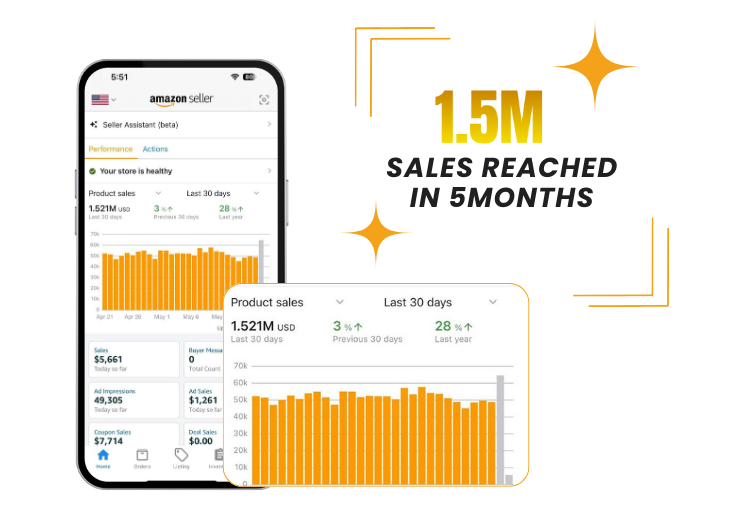
Between February 2019 and February 2020, we partnered with a growing retail brand aiming to establish long-term sales stability and brand authority in a competitive market. The client had already seen scattered monthly wins, but lacked a structured growth roadmap to turn those short-term bursts into sustained annual success.
Through a carefully planned data-driven annual strategy, we helped the brand achieve $3.694 million in total revenue, representing a 48% year-over-year growth. Beyond just boosting sales, our approach reshaped their business operations — aligning marketing, inventory, and seasonal trends under a unified framework for long-term scalability.
When we started, the brand’s sales pattern was unpredictable. While some months performed well, others fell sharply, revealing issues with timing, campaign focus, and planning. The main challenges were:
Our mission was to bring order, rhythm, and predictability to their sales — turning seasonal chaos into a structured growth cycle.
We built a 12-month roadmap focused on three pillars — seasonal insight, product timing, and strategic scaling.
We began by analyzing three years of historical data to identify recurring sales peaks and drops. Using this insight, we mapped out high-intent periods (October, August, December) and low-intent months (February, April).
This analysis allowed us to craft targeted marketing pushes around consumer demand patterns instead of random promotions.
We strategically aligned new product drops with peak traffic months.
Each launch was paired with content storytelling that tied the product to real-life moments — helping customers emotionally connect with the brand.
To handle the expected surge in demand, we optimized backend operations:
🏆 Top-Performing Months: October dominated as the most successful month, followed by August and December — confirming that well-timed launches outperform random campaigns.
📉 Low Points as Learning Points: February and April consistently underperformed, providing clear opportunities to test new offers or limited-edition collections to fill the demand gap.
📈 Sustained Growth: The 48% YoY increase reflected not just marketing improvements, but also smarter planning, improved customer retention, and operational maturity.
This holistic approach allowed the brand to maintain a steady growth curve across all quarters instead of relying on one or two big months. It also gave the management team full visibility into what drives their success and when to act on it.
Through a year of experimentation, adaptation, and precision, we transformed this retail brand’s operations into a predictable growth engine — one that turns data into decisions and timing into revenue.
Today, the same strategy serves as a benchmark for Leather Kart’s annual growth planning, ensuring every campaign is guided by insight, not intuition.
FBA Harbor completely transformed how we manage our account. From keyword optimization to inventory planning, everything became smoother. Within three months, our sales increased by over 40%. Their communication and support are unmatched.
Working with FBA Harbor feels like having an in-house Amazon team. They handle our PPC, listings, and reports so efficiently that we finally have time to focus on expanding our product line. Their strategies actually deliver measurable results.
I’ve worked with several agencies before, but none provided this level of transparency. The team at FBA Harbor shares detailed reports every week and keeps me updated on every step. My account health and sales have never looked better.
Before FBA Harbor, I was stuck dealing with policy issues and low visibility. They audited my account for free and fixed everything within days. Now my listings rank higher, and I’m finally profitable again. Highly recommended!